Brazil Election Defeats Trump Ally, Reshaping West Hemisphere Alliances
President Luiz Inácio Lula da Silva won 51.8% of the vote on Sunday, ending a seven-year conservative streak in Latin America and complicating U.S. tariff and mineral strategies.
By Peter Sullivan ·
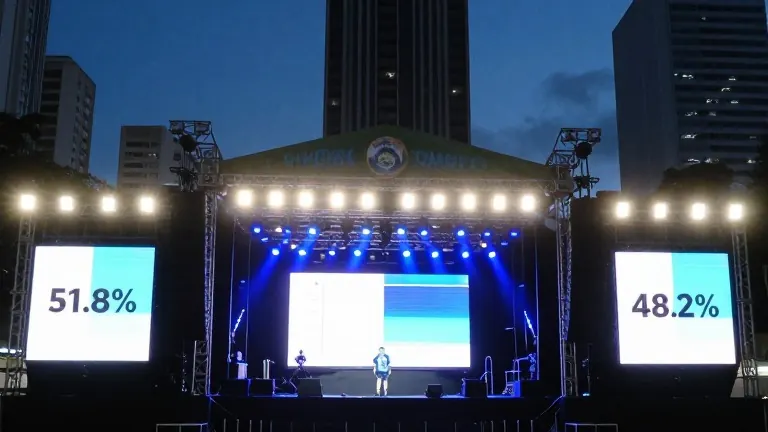
Brazilian voters rejected the region’s conservative surge on Sunday, electing President Luiz Inácio Lula da Silva to a fourth term. Lula defeated Flávio Bolsonaro by a margin of 3.6 percentage points, securing 51.8% of the vote to Bolsonaro’s 48.2%. This result interrupts a sequence of seven consecutive conservative presidential victories in Latin America over the past 18 months.
The outcome limits the influence of the Trump administration in the Western Hemisphere. Washington has pursued a strategy of tightening control through tariffs, sanctions, and military force. A Bolsonaro victory would have left Mexico’s President Claudia Sheinbaum as the only progressive leader among the region’s major economies. Now, Brazil stands as a counterweight to Washington.
President Donald Trump questioned the validity of the election results on Monday. Speaking before departing for a rally in Mississippi, Trump stated, “I thought it had a very bad look, the way it was tabulated.” He suggested the vote was “rigged” but did not provide evidence. Flávio Bolsonaro has also refused to concede and called for the result to be annulled. Despite his criticism, Trump said he has a good relationship with Lula, adding, “I like Lula. I get along with him very well.”
The election complicates U.S. efforts to enlist Brazil in a military coalition against cartels and to secure preferential access to critical minerals. Will Freeman, a fellow for Latin America studies at the Council on Foreign Relations, noted that Lula is pragmatic enough to find a working arrangement with the Trump administration. He added that the Bolsonaros’ allies in Washington will likely lose influence after the family’s second electoral defeat. Freeman said, “I’m not sure anyone in the Trump administration, beyond a few individuals, will want to keep making the Bolsonaros the central issue in the U.S.-Brazil relationship.”
Lula’s campaign leaned heavily on national sovereignty. Trump imposed double-digit tariffs on Brazilian goods to punish Brazil for prosecuting former President Jair Bolsonaro over a coup plot. Lula channeled the nationalist backlash into the slogan “Brazil belongs to Brazilians.” Kenneth Roberts, a professor of government at Cornell University, explained that defending Brazilian national sovereignty has become a form of defending Brazilian democracy. In his victory speech, Lula described the outcome as “a demonstration that this country does not accept being anyone’s backyard.”
Brazil has resisted joining the Shield of the Americas, a U.S.-led military coalition targeting cartels. In May, the U.S. designated Brazil’s two largest criminal factions, the First Capital Command and the Red Command, as terrorist organizations. Lula warned these labels could serve as a pretext for American intervention. Brian Winter, editor-in-chief of Americas Quarterly, observed, “Brazil is not Honduras. It’s a large country with a very independent history and a military that would not look kindly upon foreign troops in its own territory.”
Critical minerals remain a key point of contention. Brazil holds the world’s second-largest known reserves of rare earths and produces approximately 90% of the world’s niobium. Last month, USA Rare Earth, in which the U.S. government holds a stake, completed a $2.8 billion takeover of Serra Verde, a Brazilian firm owning one of the few mines outside Asia producing all four rare earths needed for powerful magnets. Monica de Bolle, a senior fellow at the Peterson Institute for International Economics, said the deal is on Lula’s radar for review. She noted, “Brazil has leverage. With Lula, the U.S. is on shakier ground.”
Lula faces domestic challenges as he prepares to govern. Conservatives expanded their ranks in the Brazilian Congress during the Oct. 4 elections, depriving Lula of the support needed for major reforms. Guilherme Casarões, an associate professor of Brazilian studies at Florida International University, stated, “Lula has his hands tied. Pretty much everything he has tried to do has been blocked in Congress.” Voters remain focused on safety and the cost of living as Lula begins his new term.
Source: Daily Breeze · original report published
More News · Los Angeles news · Report a business · Got a Story?